The Receiver Is the Codec
Companion to Compressed Medicine · Communication as a property of the receiver
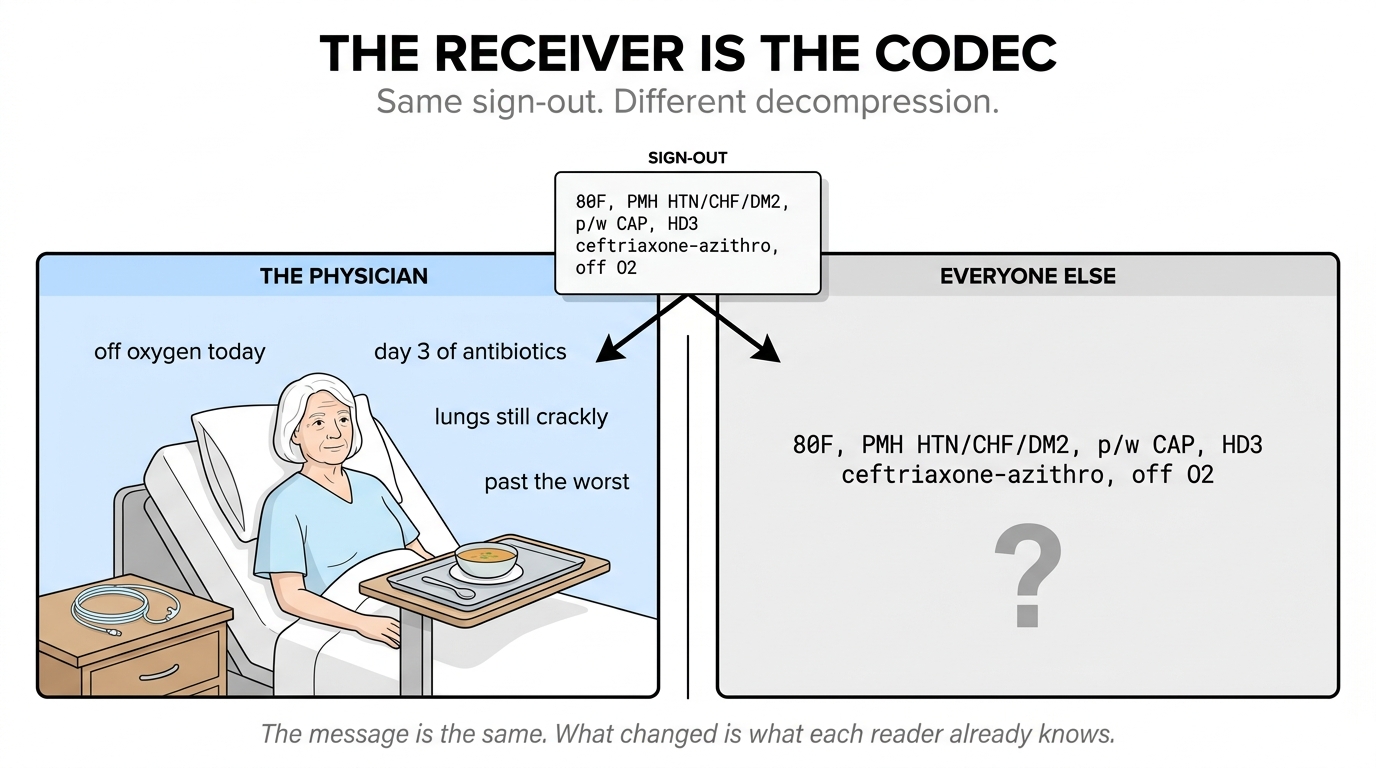
On the sign-out, a resident writes a single line: "80F, PMH HTN/CHF/DM2, p/w CAP, HD3 ceftriaxone-azithro, off O2." To the incoming physician, that line decompresses into a patient. An older woman, propped up in bed, oxygen tubing curled away on the bedside table for the first time this admission, lungs still crackly but past the worst, slowly working through a tray of soup. To anyone else, it is a code.
This is the part of communication we almost always miss. We act as if the words carry the meaning, as if a clear sentence is a property of the sentence. It isn't. The same line is brilliance in one room and noise in the next. What changed is the receiver.
You have lived this. Pick a domain you know well: a sport, a craft, a corner of code, an instrument. Recall a sentence from inside it. "Pulled the trigger on a 9-iron from 145." "Refactored the reducer to dispatch on intent." "Lead sheet, key of F, walk into the bridge." A few words to someone inside. Gibberish to anyone else.
The slogan in the title overstates by one degree. The codec isn't owned by the receiver; it is jointly held — built by shared training, shared profession, shared conventions, paid for at both ends. But the message's success is a function of the receiver's codec specifically, because the sender can only choose what to send; the decompression happens on the other side. The corollary is the load-bearing one: a message without an accompanying codec is nothing. There is no inherent good message, only a good message-codec pair. From where the sender sits, the receiver is the limiting condition — which is what makes the slogan worth saying even when it isn't strictly right.
What makes the decompression possible is what the receiver already knows. The incoming physician unfolds that line because they have spent years building a model of pneumonia in older patients: its presentation, its trajectory, the way it answers to antibiotics by day three. The model is already in them, idle, waiting to be pointed at. The line does not deliver the patient. It points to a patient they can already construct.
The compression is therefore not inside the sentence alone. It is distributed across the sentence, the receiver's training, the local conventions, and the task the receiver is about to perform.
Reading the sign-out is an act of inference, not retrieval. They do not pull the real patient out of those few abbreviations; they construct a plausible patient consistent with them and their own priors. The patient in their head is a hypothesis, with edges and gaps their training tells them to expect. Two physicians given the same line might construct slightly different patients, and both can be right. The line underdetermines the patient, and each fills in what their own experience makes most likely. The compression worked; the decompression always has error bars.
The safest failure of this process is confusion. A confused receiver asks for more. The dangerous failure is fluent misreconstruction: the receiver thinks the message landed, but the patient they built from it is not the patient the sender meant to send. This is the receiver-side failure mode: what gets silently filled in, when the message itself does not flag what is missing.
The other thing we miss is the cost. That single line only exists because an entire profession paid for it: a decade of medical training per physician, residencies that drill the codec into the receiver until it fires without conscious effort, decades of accumulated convention about what to keep and what to drop. Every efficient compression you have ever seen is the visible tip of an invisible investment. Jazz musicians can pass a chord chart back and forth in a single line because both have spent years shedding. Programmers can describe a refactor in eight words because the language and the team paid for those eight words across thousands of hours. When communities don't pay this cost, communication stays slow. They have to send the whole picture every time, because no shared codec exists to point at.
This reframes a lot. The writer praised as lucid is not necessarily clearer than the writer dismissed as obscure; they may simply be writing to the receiver they have, with the priors they have. "Plain English" is plain to people who share a model of plain English. Translation is hard not because words lack equivalents, but because receivers do. The same mechanism that makes expert shorthand efficient also makes it exclusionary when the receiver is not inside the code. The line that hands a patient to one physician hands a wall to everyone else.
It also reframes good communication. The work is to model what the other person already knows, and to choose a compression that lands inside their model. Saying it more clearly is downstream of that. Teachers do this. Doctors do it every time they shift from sign-out to consult. Writers do it every time they choose a metaphor, borrowing the receiver's prior to deliver a new one.
Pragmatics has been saying this for half a century: Grice on the cooperative principle, Clark and Brennan on grounding in common ground, Sperber and Wilson on relevance theory. The observation is not fresh on the linguistics side. What those literatures did not have, and what the rest of these essays add, is the architecture of how it breaks at scale, with new failure modes that come from putting a new kind of processor in the chain.
So the next time a message feels lucid, notice what does the work. You do. The sentence only points.
A standalone companion to the Compressed Medicine curriculum. Related: The Function of the Message · Compression Engines · The Algebra of Thought.