The Minimum Sufficient Message
Compressed Medicine · 5. The Minimum Sufficient Message · Just enough, the principle of the tuned message
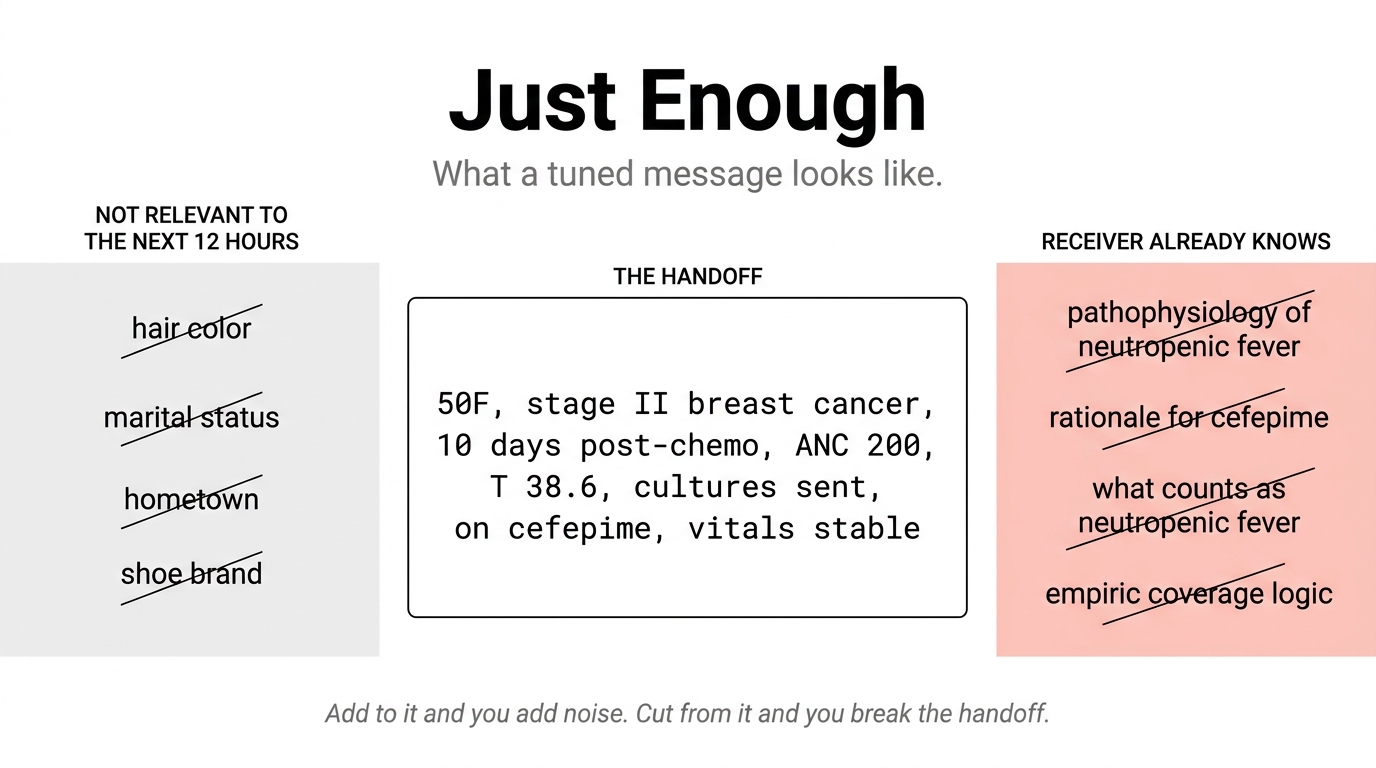
There is a sentence physicians say to each other at change of shift, and it goes something like this: "Fifty-year-old woman, stage II breast cancer, ten days post-chemo, ANC 200, spiked to 38.6 this afternoon, blood cultures sent, on cefepime, vitals stable." Twenty-something words. To someone outside medicine, that is mostly code. To the next physician, it decompresses into a complete person and a complete plan, and into most of what they need to make safe decisions for the next twelve hours.
Notice what isn't in there. Her hair color. Her marital status. Her hometown. The brand of her shoes. None of it useless in some absolute sense; all of it part of who she is. But none of it bears on the next twelve hours of clinical decisions, and so none of it is sent.
Notice also what isn't in there because it doesn't need to be. The pathophysiology of neutropenic fever. The rationale for cefepime as empiric coverage. The reason 38.3 once, or 38.0 sustained for an hour, means business (IDSA guideline, 2011). All of it is in the receiver already. Sending it would not add information; it would only crowd the channel.
What you are watching is a message tuned over years to a point. The sign-out has been compressed by an entire profession trying to hand off patients quickly and safely, against a clock, with consequences. Words that did not earn their place fell away. Words that the receiver could supply from their own knowledge fell away. What is left is close to the shortest message that lets the next physician do their job correctly.
There is an ideal this is reaching toward. A handoff has reached it when the next physician can make the next twelve hours of decisions safely without calling you back; every detail that still changes what to do is present, and everything else has been left behind. Add to it and you add noise. Cut from it and you break the handoff. That is what a minimum sufficient message looks like: the smallest package that still lets the receiver act correctly, and not a syllable smaller. It is the clinical analog of a sufficient statistic in Fisher's sense, or of the rate-distortion optimum that the information bottleneck formalizes: the smallest representation that preserves what matters for the decision downstream. In decision-theoretic terms the target is Markov-sufficient — the smallest current-state object that contains everything the receiver needs to choose their next action without re-deriving the history.
A message is never sufficient in the abstract. It is sufficient for a particular receiver, doing a particular task, over a particular time horizon. Change the task and the same compression may become unsafe. Change the receiver and it may become opaque. Change the time horizon and what was irrelevant may become decisive.
The inverse case matters just as much. Sometimes more is correct. A receiver with unfamiliar priors needs the things the standard handoff would skip. An atypical case needs the rationale that an experienced receiver would supply for themselves. A medico-legal record needs to preserve what the bedside does not. The principle is fit-to-task: compress to whatever the particular receiver, task, and time horizon actually require, which sometimes means expand rather than compress.
Most of what we send is not like this. Email bloats because we are not sure what the receiver knows, so we send too much. Slack messages are too sparse because we assume the receiver has context they don't, so we send too little. Meetings are reruns because the priors were never aligned in the first place. The gap between what we say and what would actually have been enough, measured in either direction, is the gap between us and a tuned channel.
The trick is to model the receiver well enough to know which words are still doing work. Writing shorter messages is the wrong instinct. As shared priors grow, less needs to be transmitted: the attending needs fewer words than the medical student; old colleagues finish each other's sentences; long marriages can travel a whole argument in a glance. The message shrinks because the codec on the other side grew.
It is worth saying what the opposite of this looks like. Compression becomes dangerous when it drops action-changing information while preserving the appearance of completeness. A fluent sign-out missing the penicillin allergy reads as a confident packet, not as noise, and decompresses cleanly into the wrong patient. The danger of lossy communication is the missing things going unflagged, fluent gaps the receiver fills in without knowing they are filling in.
This is what efficient communication is, when you strip it down. Not brevity. Not eloquence. A minimum sufficient message, tuned to a particular receiver, carrying just enough to let them reconstruct what they need to act, and not a syllable more. There is a limit, and most of us are very far from it.
A clinical AI inherits the same target. Its output is not thorough when it dumps the chart and not helpful when it omits the discriminating fact. The target is Markov-sufficient for the receiver's next decision — for this clinician, for this function, in this moment. A scribe that copies everything the patient said misses the discipline. A copilot that returns a fluent summary missing the action-changing fact misses it differently. The system that helps is the one that has modeled the receiver well enough to know which words are still doing work.
Compressed Medicine · Preface · 1. The Compression Substrate · 2. The Function of the Message · 3. The Highest Accurate Abstraction · 4. The Decompression Order · 5. The Minimum Sufficient Message · 6. The Grounding Constraint · 7. The Belief-State Object · 8. The Same Wall · 9. The Defense Architecture · 10. The Temporal Loop · 10.1 The Connection · 10.2 Quiet Verification · 10.3 Quiet Acquisition · 11. The Irreversible-Action Check