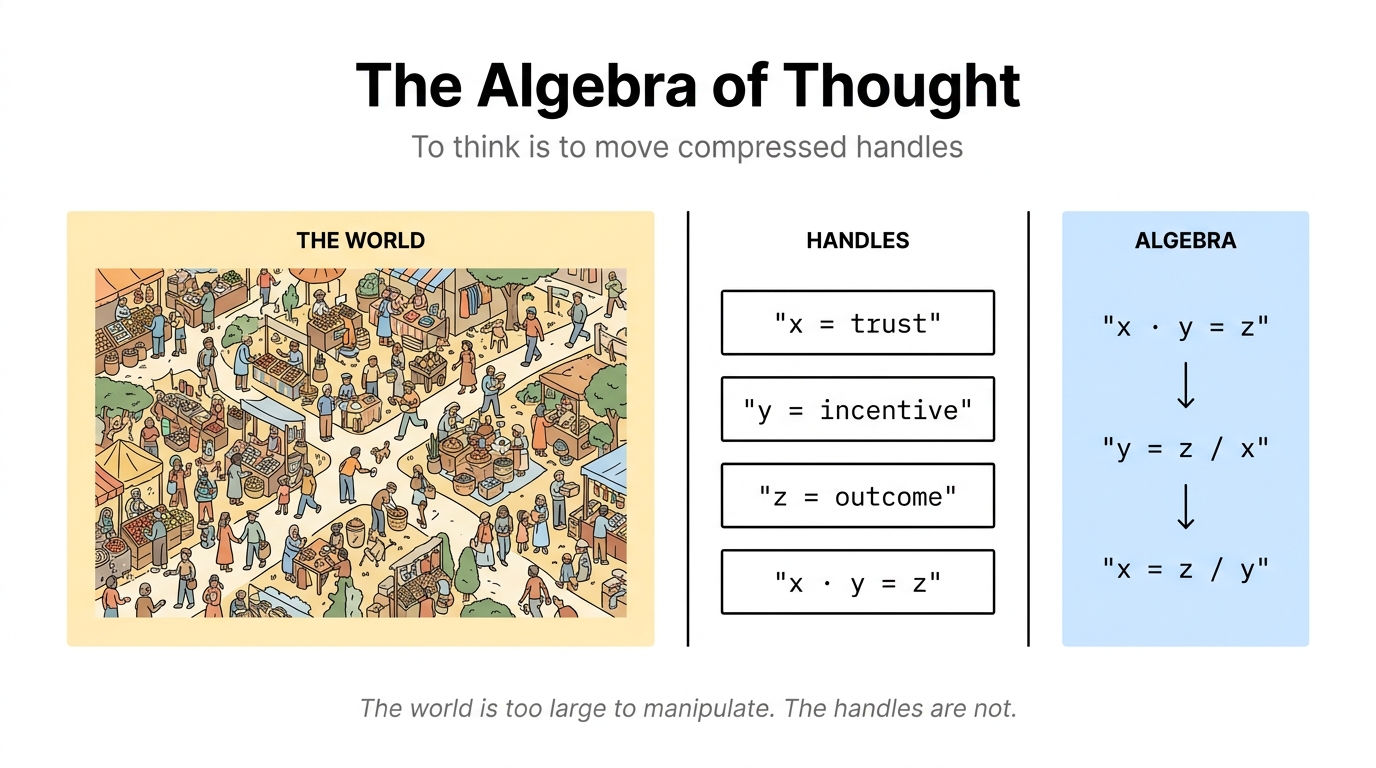
The Algebra of Thought
Companion to Compressed Medicine · To think is to compress and decompress
Try this. Pick a friend you know well. Now imagine telling them something that would upset them. You did not, while imagining this, load their entire personality. You did not summon every conversation you have ever had with them. You ran a simplified version, a small fast model of them, and watched how it reacted. The model was wrong in many small ways. It was right enough to be useful. You had your answer in two seconds.
This is what thinking is.
You cannot hold the world in your head. You cannot even hold a single person in your head. What you can hold is a handle: a compressed version, small enough to fit, simple enough to manipulate. Thinking is the act of moving those handles around: substituting one for another, comparing them, combining them, running them forward in time to see what they do. At the end, if it matters, you check the handle against reality and see whether the answer survives.
The cleanest case of this is algebra.
When you write x on a page, you do not know what x is. You manipulate it anyway. You add it to other letters, multiply it, move it across an equals sign. You follow rules that don't care what x stands for. At the end, if you need to, you substitute back. But the thinking happened in the world of letters, not in the world of numbers. The whole power of algebra is reasoning about something without unpacking it.
What you see in algebra is what all thinking does: compress, transform, decompress.
A note on register, since the claim widens here. In information-theoretic settings the compression is literal: retinas dropping bits before anything leaves the eye, memory storing gists. Here, the frame becomes more analogical. Handle is a metaphor, not a defined lossy encoding under a distortion criterion. The shape transfers because the finite-capacity constraint still bites. The formal rigor does not always travel with it.
Every concept you have ever used is an x. "Inflation," "fear," "trust," "pneumonia," "the market": each is a vast and varied phenomenon collapsed into a single token you can move around. You reason about the token, not the cases. You compare tokens to each other. You link them. You run scenarios on them. Then, when the answer needs to matter in the world, you decompress: you check the token against the actual cases, and you see whether reality cooperates.
Handles can be built on top of handles, and most of the work happens in those stacks. Septic shock from obstructing infected stone is one token in five words, but it contains at least three sub-handles — septic shock, obstructing, infected stone — each itself a compression of many particulars. A trained clinician hearing the phrase decompresses all three layers in parallel and composes them into an operational picture. Language is the general case: a sentence is a stack of handles, a paragraph is a stack of stacks, and the depth of the composition is what makes ordinary language absurdly compressed for its receivers, and entirely impenetrable for anyone outside the codec. When a token represents something that itself represents something, the compression compounds — and so, when the stack mis-aligns between sender and receiver, does the failure.
The reason we work this way is simple. The world is bigger than any of us. We can hold a few things in mind at once, not millions. The only form of reality we can manipulate mentally is the compressed form, because the uncompressed form does not fit. Thinking and finitude are the same problem. Compressed handles are how finite minds get any work done at all.
Mental models are this in slow motion. When you reason about a market, an organism, a piece of code, a relationship, you are running a compressed simulation. Most of what's actually there is not in your head. What's in your head is a small set of relationships you've extracted, the variables you've decided matter, the dynamics you've encoded as rules of thumb. You run scenarios on the model. You see what comes out. When reality surprises you, the surprise is a signal to update the handle: to add a variable, change a rule, sharpen a category.
Analogy is the same operation pushed one level further. When you say one thing is like another, you are noticing that two compressed handles have the same shape. Once you see the shape, you can transfer conclusions from one domain to the other without re-deriving them. This is how a physicist's intuition reaches biology. This is how a doctor's intuition reaches a new patient. The handles are different on the surface; the algebra underneath is the same.
Imagination is the same operation in the open direction. You combine handles you already have in arrangements you have not seen, and you ask the mind to run the simulation forward. The handles are old; the combination is new. Almost everything you call creative is built this way, not from raw material, but from old material in arrangements that have not been tried.
Reasoning fails when the handle goes stale. You keep thinking with a token that no longer fits the cases it stands for. The market changed and your handle didn't. Your handle says "typical patient"; the patient in front of you is something else. The discipline that keeps thinking honest is the discipline of going back to reality and checking, let me look at the actual case, and letting reality update the handle. Without that step, thought drifts into confident wrongness. With it, the handle slowly improves.
This is the same failure mode that produces diagnostic error and AI hallucination, dressed in different clothes. Anchoring, premature closure, base-rate neglect: these are stale handles in the clinician's head. A language model filling a confident gap with the most plausible training-time pattern is a stale handle in the model's. The compression failed the same way in both cases. A confident representation, decoded from an outdated or mismatched prior, never checked against the case in front of the reasoner. For a structural decomposition of this failure mode in clinical and other high-stakes settings — diagnosis, intelligence analysis, aviation, distributed systems — see The Same Wall.
There is one further thing to notice, and it is the part that is hardest to see clearly because you cannot step outside yourself to look. The "you" that runs all of this thinking is itself a compressed handle. The story you tell yourself about who you are, what you want, what you have done, that story is small enough to fit in a single mind. The actual person, the body, the history, the trillion micro-events that made you, does not fit. The self you call "I" is the same kind of object as every other concept you think with: a compact handle for something far larger than the handle.
There is another layer hidden inside the experience of being one person at all. Your brain is a distributed set of specialized systems and networks, not a single processor. Partially segregated, densely interconnected, linked by long-range white-matter pathways (Felleman & Van Essen, 1991; Sporns, 2013). What you experience as a single thought is many such systems exchanging abbreviated, transformed signals with one another. The "mind" that feels like one place is actually a coordinated conversation between many places. In the language of this essay, each system can be thought of as handing the others a compressed summary rather than the whole raw stream. The compression doesn't only happen between you and someone else; it happens between the parts of you, moment to moment.
This is why thinking and communicating are the same operation across different gaps. When you talk to someone else, you pass compressed handles across a gap. When you think alone, you pass compressed handles between one moment of yourself and the next, and below that, between the parts of yourself that produced the thought in the first place. Inner speech is communication between time-slices of one processor. Memory is sending to your future self. The compression that lets two people understand each other is the same compression that lets one person understand themself across an afternoon, and the same compression that lets one system in the brain hand information to another.
The world is too large for any of us. The compression is the only way in.
A standalone companion to the Compressed Medicine curriculum. Related: Compression Engines · The Belief-State Object · The Same Wall.