Compression Engines
Compressed Medicine · 1. The Compression Substrate · Why everything we see is already a compression
Before any message is compressed, the world is.
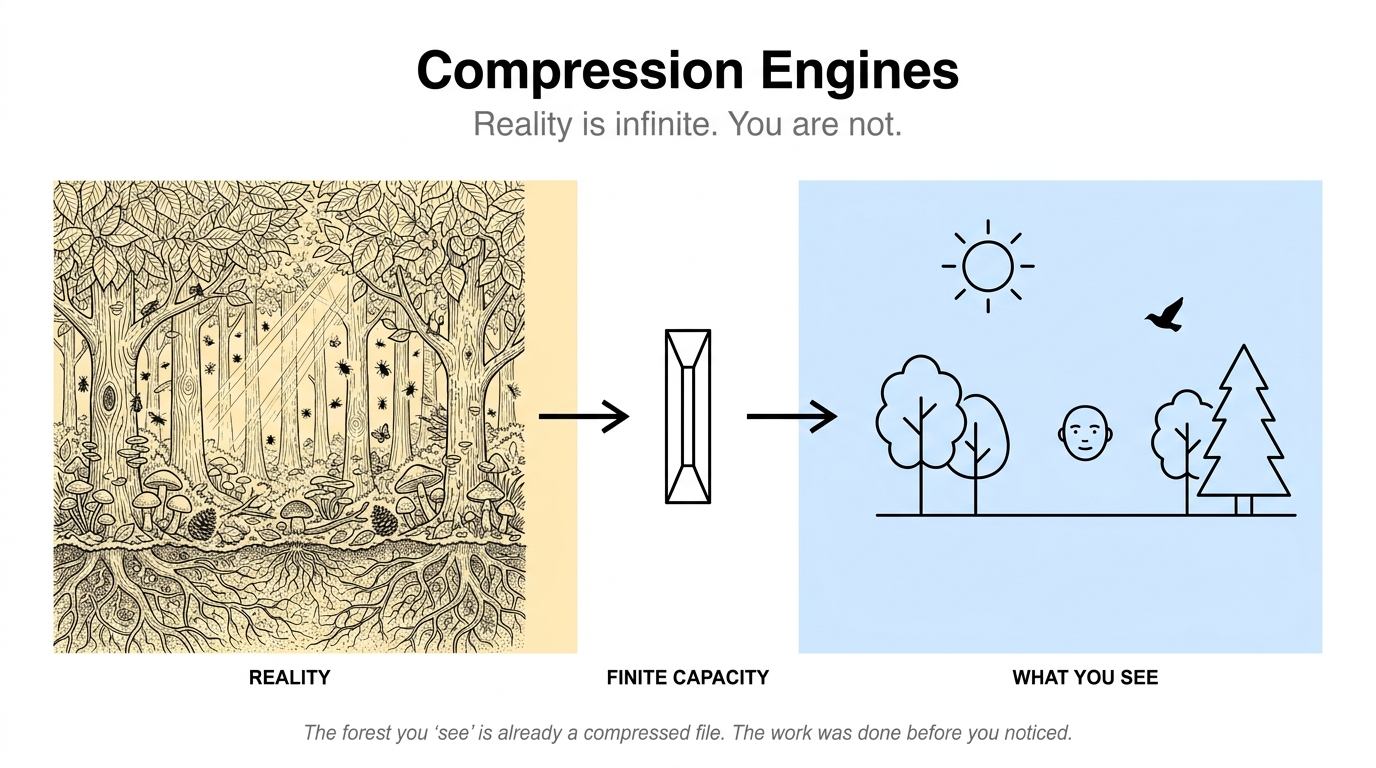
Stand in a forest for one minute and try to take it in. Every leaf has veins. Every vein has cells. The bark has scales. The light changes as the wind moves. The wind itself is made of pressure waves you cannot count. Insects you cannot name are doing things you cannot see. The smell is hundreds of molecules. The ground beneath your feet is a fungal network deeper than your body. There is no scale at which the detail stops.
You cannot take it in. Not because you are insufficient, but because reality is not bounded the way you are. The world has, for practical purposes, inexhaustible detail. You have a few pounds of brain. You have finite sensors, finite attention, finite memory, finite time. The math does not work.
This holds for any bounded agent, not just humans: an organism, a clinician, a hospital, a model, a machine. If the world is larger than the system representing it, representation must be selective.
So the brain throws almost all of it away. It keeps edges, motion, the few colors and frequencies that mattered to our ancestors, faces, a tiny window of focus. The forest you "see" is already a compressed file; the work was done before you noticed. Perception is a codec, not a window. Rules for what to keep, rules for what to put back, running so fast you mistake it for raw input. The retina alone compresses on the order of a hundred million photoreceptors into about a million ganglion cells before anything leaves the eye, in ways the efficient-coding tradition has been formalizing since the 1960s (Barlow, 1961; Olshausen & Field, 1996).
A note on the word compression, since I use it broadly in this series. I mean any lossy transformation from a larger reality into a smaller representation, one you can store, transmit, reason over, or act on. A handoff, a memory, a chart note, an equation, an AI summary: all compressions in this sense. The file-size sense is one instance of the broader pattern, not the whole of it.
The narrower claim is this. None of those systems can begin without first deciding what to preserve, what to discard, and what form the remainder must take. Compression is deletion plus structure. The discarding is not the work; the work is choosing what to discard and what shape the remainder takes, so the receiver can rebuild what matters.
The family is wider than the word usually suggests. Selection keeps some variables and ignores others. Attention allocates bandwidth to a small part of the world. Abstraction replaces many particulars with a handle. Categorization maps continuous variation into usable types. Modeling preserves some relations while discarding others. Prediction and inference use a smaller model to stand in for missing reality. These differ in mechanism. They share one constraint: a bounded system must reduce more reality than it can hold into something it can use.
They also stratify, and the rest of this series depends on the stratification. At the bottom is the cold filter: signals admitted or dropped, bits in or out — the retina dropping photons, attention ignoring the rest of the visual field, no red flags on a review of systems. Above that is handle formation: many signals collapsed into one reusable token that points at a pattern — toxic-appearing, volume overloaded, DKA. A handle is not just shorter; it stands in for the pattern, and the pattern is what the receiver loads when the handle arrives. Higher still is handle composition: handles built on top of handles. Septic shock from obstructing infected stone is one such stack — three handles in five words, decompressed in parallel by a receiver who shares the codec. Language is the canonical case of iterated compression: meanings stacked on meanings, with the depth of the stack carrying the cognitive economy. Every clinical sign-out, consult question, and chart note in this series is several layers of composed handles, decompressed by the receiver in tandem. Compression across this curriculum means any of the three modes, and the mode in play is sometimes the difference between failure being recoverable or invisible. The companion essay The Algebra of Thought develops the cognitive side.
The same is true of memory. You cannot store a year of your life; you store fragments. A few scenes, a few feelings, a story that lets you reconstruct the rest plausibly (Schacter, Addis & Buckner, 2007). Your autobiography is a compressed file too, decompressed on demand into something that feels continuous.
The same is true of language. You cannot say everything about the patient, the case, the day; you say enough that the next person can reconstruct the rest. The same is true of science. A map cannot be the territory; no map could be. A model cannot be the system in full. An equation is a compression of behavior across infinite cases into a finite expression you can hold in your head.
This is why a clinical handoff works at all. When a physician compresses a patient into nine words for the next doctor on shift, they are not being terse. They are compressing because they have to. The patient was never available in full to them either. Both ends of the handoff are already running compression. The message between them is a third compression, tuned to the priors of the receiver. Communication is what happens when two compression engines agree on a shorthand for what they share. A handle is only compressed for a receiver who has the codec — the stored handle-to-pattern mapping. DKA is three letters for an emergency physician and almost empty for a layperson. The compression does not live in the string alone; it lives in the string plus the receiver's decoder. We talk about messages as if they cross between full minds. They don't. They cross between two already-compressed substrates, with the message itself compressed again to fit the bandwidth between them.
We tend to treat this as a defect, if only I could see the whole picture, hold it all at once. But the picture cannot be held. Anything that holds requires a holder, and any holder is finite. Compression is the work itself, not a defect in the work. There is no view from nowhere; there are only compressions, each made by some finite thing trying to fit some piece of the world into the room it has.
We tend to call ourselves thinking creatures. It might be more accurate to call ourselves compression engines that experience their own compression. The forest you remember is a thumbnail. The friend you love is more than any model you hold of them, but you still meet them through one, a compression built from years of contact. The self you call "I" is a story compact enough to survive in a few pounds of tissue.
There is loss in any compression. The alternative is no representation at all, not "no compression." The choice is never compression or no compression. The choice is which compression, and what gets thrown away to make the rest fit.
A clinical AI is not outside this system. It is another compression engine, with its own filter, its own handles, and its own composed handles built from training-time priors that may or may not match the priors the clinician on the other side of the channel is decompressing against. Its safety depends on whether that compressed representation can be inspected by the human, translated into the codec the clinician is operating in, grounded against the evidence that earns each handle, and corrected before action commits. The rest of this curriculum walks that architecture.
Compressed Medicine · Preface · 1. The Compression Substrate · 2. The Function of the Message · 3. The Highest Accurate Abstraction · 4. The Decompression Order · 5. The Minimum Sufficient Message · 6. The Grounding Constraint · 7. The Belief-State Object · 8. The Same Wall · 9. The Defense Architecture · 10. The Temporal Loop · 10.1 The Connection · 10.2 Quiet Verification · 10.3 Quiet Acquisition · 11. The Irreversible-Action Check